INSIGHTS
AI search optimization articles, guides, and playbooks
Actionable coverage of SGO, GEO, AEO, answer engine visibility, AI Overviews, ChatGPT Search, Perplexity, and content citation strategy.
Foundations
Definitions and frameworks for the new search vocabulary.
Playbooks
Step-by-step workflows for content teams and SEOs.
Checklists
Practical quality gates before publishing or refreshing content.
- AI Search Optimization Audit: 30-Minute Checklist for Pages With Impressions and Low CTR
- AI Search Is Layering on Google: What New Traffic and Search Console Data Mean

- AI Search Content Brief Template: Build Pages That Can Earn Citations and Clicks

- Generative Engine Optimization Research: Practical Takeaways for SEO Teams
- Google Open Knowledge Format Trust Signals: What SEO Teams Should Learn
- AI Search CTR: How to Turn Early Impressions Into Clicks
- Robots.txt Is Not Noindex: What AI Chat Pages Teach SEO Teams
- Google AI Content and Thin Content: What SGO Teams Should Fix Now
- ChatGPT Yelp Integration: What Local SEO Teams Should Update for AI Search
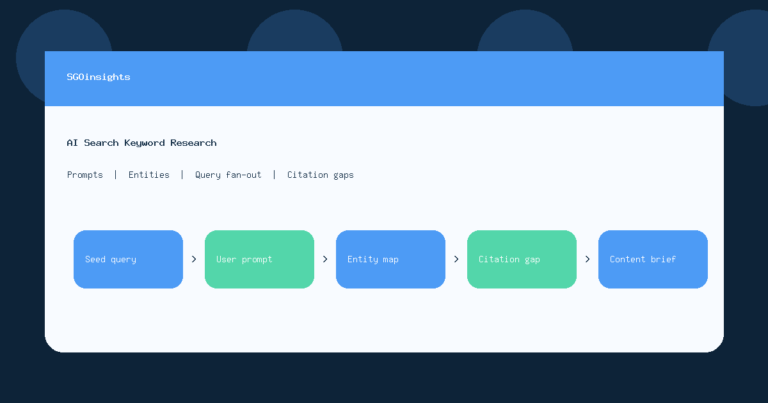
- AI Search Keyword Research: How to Find Prompts, Questions, and Citation Opportunities
- Google AI Mode Optimization Checklist: 21 Checks for SEO and SGO Teams
- Local AI Overviews: What Businesses Should Update for AI Search Citations

How to get value from this page
This page is designed for readers tracking AI search, GEO, AEO, SGO, and SEO changes. Use it as a practical starting point for SGOinsights articles and analysis, then move into the linked guides, tools, templates, or examples when you need more detail.
For AdSense, search quality, and reader trust, a hub or resource page should do more than list links. It should explain what the topic means, when the page is useful, how to act on it, and where a reader should go next. That is the standard SGOinsights applies to important pages.
Recommended workflow
Pick one priority page, query, or topic. Review the available guidance, run the relevant checklist or scanner if one is available, and write down the next three changes. Good AI-search work is usually a series of small, verified improvements rather than one large rewrite.
- Clarify the direct answer near the top of the page.
- Add examples, sources, or decision criteria where the page feels generic.
- Link to related SGOinsights guides and resources so the topic is not isolated.
- Recheck metadata, crawlability, sitemap inclusion, and visible content after publishing.
Reader path and next step
SGOinsights pages are meant to be used, not skimmed once and forgotten. After reading this page, choose one next action: audit a live URL, compare a competing source, update a weak section, document an AI-answer test, or move to a related guide that gives the topic more depth.
This additional context is part of the site’s quality standard. Important pages should explain why they exist, who they help, what decision they support, and what a reader should do next. That makes the page more useful for humans and gives search systems a clearer reason to crawl, understand, and evaluate it.
- If the page is a guide, use it to make a concrete content or technical change.
- If the page is a policy, use it to understand how the site handles trust, privacy, editorial judgment, and monetization.
- If the page is a resource, use it with a real URL, prompt, query, or workflow instead of treating it as a static download.
- If the topic changes, revisit the page and refresh the examples, internal links, and recommendations.
Additional context
SGOinsights keeps this page visible because trust and navigation pages are part of the reader experience. A site that publishes AI search guidance should also make its policies, ownership signals, editorial standards, and next-step paths easy to find. That helps readers understand the site and helps reviewers evaluate whether the publication is built for real use.
This page should be revisited whenever the site adds new monetization, new tools, new editorial sections, or new audience pathways. The goal is simple: a visitor should know where they are, why the page exists, and what to do next without relying on guesswork.
How to read the Insights section
The Insights section is the running editorial feed for SGOinsights. It brings together platform analysis, practical SEO guidance, AI-search measurement notes, crawler and citation coverage, and resource updates. Use it when you want to see what changed recently before moving into a deeper guide or tool.
Each article should connect a search or AI discovery change to a practical decision. That may be a page update, a new measurement habit, a source-quality review, a landing page QA pass, or a stronger internal linking path. The section is not meant to be a generic blog archive; it is the working newsroom for AI search visibility.
If you are new to the topic, start with the complete SGO guide, then use the Insights feed for current examples and tactical follow-up. If you are reviewing the site for advertising or quality purposes, this page shows the publication cadence and gives access to the article library.
For ongoing work, treat this page as a map of the publication rather than a simple date list. Recent articles can signal which evergreen pages need updates, which resources should be improved, and which AI-search topics deserve deeper coverage. That connection between news, guides, tools, and editorial maintenance is what makes the archive useful for repeat readers.
When reviewing older posts, prioritize pieces that still receive impressions, mention active Google or AI-search features, or support important hub pages. Those articles should stay accurate, linked, and useful rather than becoming abandoned archive entries.
This keeps the section useful for people who return weekly to understand what changed and what to fix next.
The archive should make useful current work easier to find.
Use the archive as a maintenance queue as well as a reading list.