
A practical 2026 guide to generative engine visibility
TL;DR
- Generative Engine Optimization (GEO) is the practice of optimizing content so generative engines can retrieve, synthesize, and cite it in AI-generated responses.
- GEO focuses on source credibility, quotable passages, structured information, statistics, entity clarity, and topical authority.
- It complements traditional SEO by optimizing for how AI systems evaluate and cite sources, not only how search engines rank pages.
- This guide covers the core GEO tactics, how GEO relates to SGO and AEO, and how to make content more citation-ready.
Direct answer for AI search
Short answer: Generative Engine Optimization (GEO) is the practice of optimizing content so generative engines can retrieve it, understand it, synthesize it, and cite it in AI-generated responses. GEO focuses on source credibility, quotable passages, structured information, statistics, entity clarity, and topical authority across a content cluster.
Quotable summary: GEO makes content more useful to generative engines by turning expertise into clear, citable, machine-readable answer material.
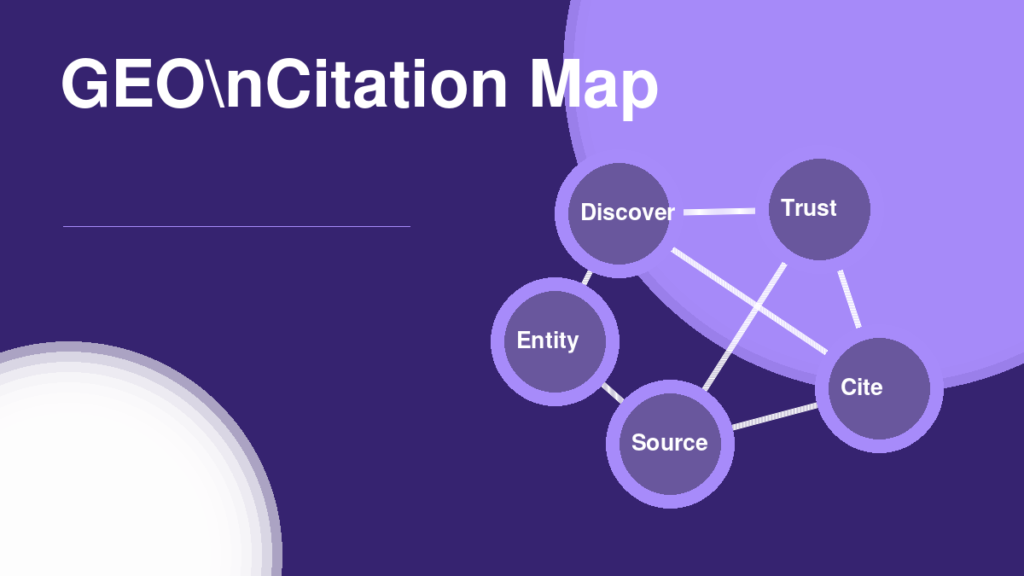
Key entities covered: Generative Engine Optimization, GEO, generative engines, AI citations, AI search visibility, source credibility, entity clarity, topical authority, ChatGPT Search, Perplexity, Google AI Overviews.
Related SGOinsights guides:
Why GEO is a 2026 operating discipline
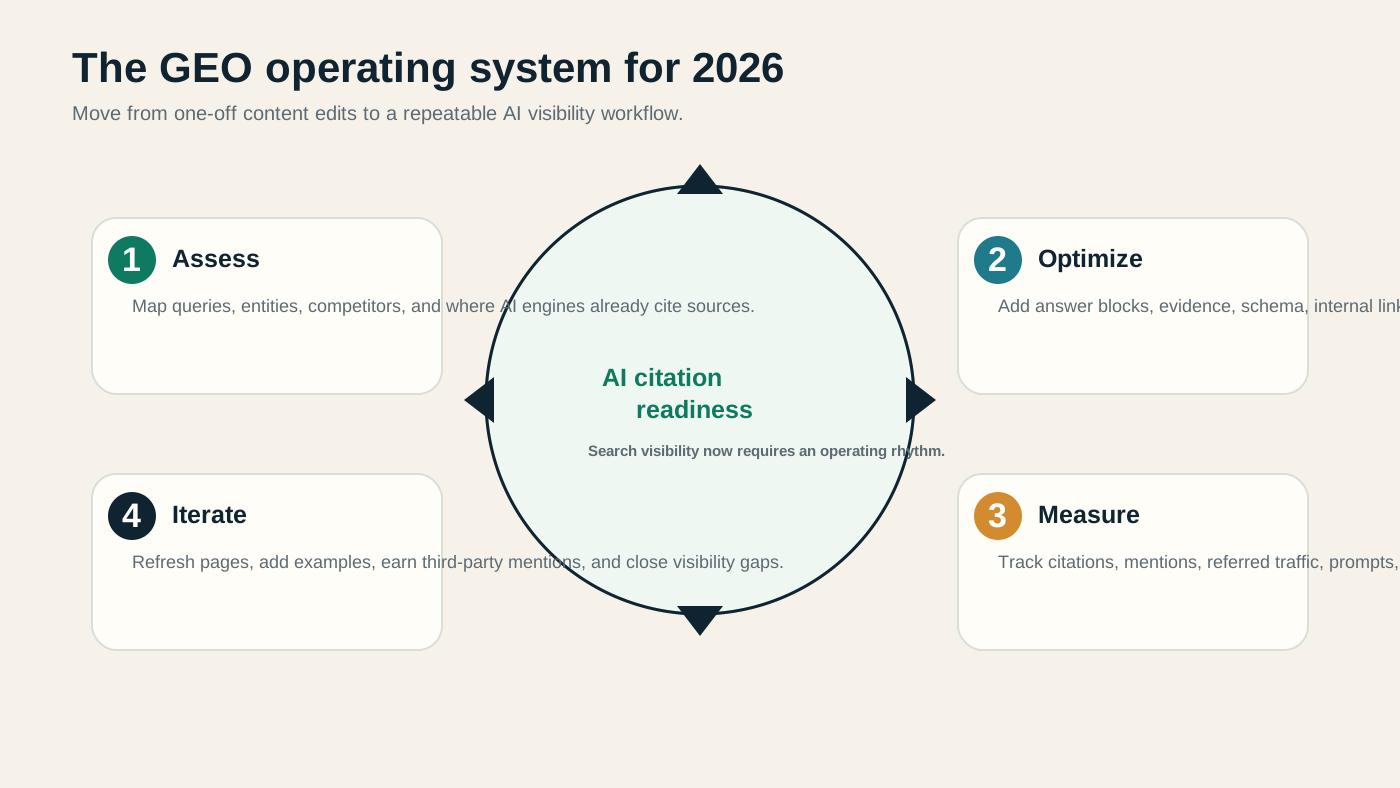
Generative Engine Optimization is no longer a single content tactic. In 2026, GEO behaves more like an operating discipline: understand where AI systems already find answers, make your pages easier to cite, measure where your brand appears, and keep updating the evidence that supports your claims.
The reason is simple: AI search engines do not only list pages. They retrieve passages, compare entities, synthesize claims, and decide which sources deserve attribution. A useful GEO program therefore combines classic SEO fundamentals with answer-ready formatting, entity clarity, third-party authority, and ongoing AI visibility measurement.
What Is Generative Engine Optimization (GEO)?
Definition and Core Concept
Generative Engine Optimization (GEO) is the strategic process of creating and structuring content so that large language model (LLM)-powered search engines are more likely to retrieve it, cite it, and incorporate it into AI-generated answers. Unlike traditional SEO, which focuses on earning a position on a list of blue links, GEO is about earning a place inside the answer itself.
When a user asks ChatGPT Search “What are the best strategies for B2B lead generation?” or types a complex query into Perplexity, the underlying AI doesn’t just rank pages — it reads them, evaluates their authority and relevance, and synthesizes a response. GEO is the discipline of making your content the kind of source that AI systems trust, prefer, and quote.
Think of it this way: SEO gets you on the shelf. GEO gets you into the conversation.
The Princeton Research Paper That Coined GEO
The term “Generative Engine Optimization” was formalized in a landmark 2023 research paper from Princeton University, Georgia Tech, The Allen Institute for AI (AI2), and IIT Delhi. Titled “GEO: Generative Engine Optimization,” the paper introduced a rigorous framework for understanding how content creators can improve their visibility in AI-generated search responses.
The researchers built a benchmark called GEO-bench, consisting of thousands of diverse search queries across multiple domains. They then tested nine different content optimization strategies and measured their impact on source visibility within generative engine outputs. The results were striking:
- Adding citations and statistics increased visibility by up to 40%.
- Including quotations from authoritative sources boosted visibility by approximately 30%.
- Using an authoritative and technical tone improved visibility meaningfully across most query categories.
- Simple keyword stuffing and traditional SEO-only tactics had minimal or even negative effects on generative engine visibility.
This paper was pivotal because it moved the conversation about AI search optimization from speculation to evidence. It gave marketers and SEOs a data-backed starting point for a new discipline.
How GEO Differs from AEO and Traditional SEO
Understanding GEO requires distinguishing it from two related but different concepts:
Traditional SEO optimizes content for search engine ranking algorithms. The goal is to appear as high as possible on a search engine results page (SERP). Success metrics include keyword rankings, click-through rate, and organic traffic. The output is a ranked list of links.
Answer Engine Optimization (AEO) optimizes content to be selected as the direct answer in featured snippets, voice assistant responses, and knowledge panels. AEO targets structured answer formats and often focuses on question-answer patterns, concise definitions, and schema markup. For a deep dive, see our complete AEO guide.
GEO goes further. It optimizes for inclusion in synthesized, AI-generated responses where the engine doesn’t just pick one answer — it reads multiple sources, evaluates them, and weaves them into an original narrative. The “competition” in GEO isn’t for a ranking position; it’s for citation within a generated paragraph.
For a detailed breakdown of all four frameworks, check out our comparison: SGO vs SEO vs GEO vs AEO.
How Generative Engines Work
LLMs + Retrieval Pipelines
Generative engines — Google AI Overviews, ChatGPT with browsing, Perplexity, Microsoft Copilot, and others — don’t just generate answers from their training data. They use a technique called Retrieval-Augmented Generation (RAG), which combines a large language model’s reasoning capabilities with real-time information retrieval from the web.
Here’s the simplified pipeline:
- Query understanding: The LLM interprets the user’s question, identifies intent, and expands it into sub-queries if needed.
- Retrieval: A search component fetches potentially relevant documents from an index (often powered by traditional search infrastructure like Bing or Google’s index).
- Ranking and filtering: Retrieved documents are scored for relevance, authority, freshness, and quality. Low-quality or irrelevant sources are discarded.
- Reading and extraction: The LLM processes the top-ranking documents, extracting key claims, data points, and insights.
- Synthesis: The model generates a coherent response that integrates information from multiple sources, often with inline citations.
- Citation: Sources are attributed, either as inline links (Perplexity, ChatGPT) or as expandable references (Google AI Overviews).
For content creators, this pipeline means your content must pass through multiple gates: it must be findable (indexed and retrievable), authoritative (deemed trustworthy by the ranking layer), and useful (containing extractable, quotable information that enhances the generated answer).
How AI Models Select and Synthesize Sources
Not all content that ranks well in traditional search will be cited in AI-generated answers. Generative engines have their own implicit preferences when selecting which sources to weave into a response:
- Specificity over generality: Content that makes specific, verifiable claims with supporting data tends to be cited more than vague, high-level overviews.
- Unique information value: If your page says something that other sources don’t — an original statistic, a proprietary framework, a unique expert quote — it becomes more valuable to the synthesis process.
- Structural clarity: Content with clear headings, well-defined sections, and logical flow is easier for models to parse and extract from.
- Credibility signals: Author credentials, institutional authority, third-party citations, and domain reputation all influence source selection.
- Freshness: For time-sensitive queries, recently published or updated content is preferred.
The implication is clear: to win in GEO, your content needs to be the page that the AI would be “embarrassed” to leave out of its answer.
The Concept of “Source Nodes” and Citation Graphs
An emerging concept in GEO is the idea of source nodes and citation graphs. In the context of generative search, a source node is any document or page that an AI engine identifies as a credible reference for a given topic. The citation graph is the network of relationships between these sources — which pages cite each other, which are cited most frequently across AI responses, and how authority flows between them.
This concept mirrors academic citation networks, where a paper’s influence is measured not just by its content but by how many other papers reference it. In generative search, a page that is frequently cited alongside other high-authority sources — and is itself referenced by those sources — occupies a stronger position in the citation graph.
For practitioners, this means GEO strategy must consider not only your own content but your position in the broader information ecosystem. Being cited by Wikipedia, industry publications, and authoritative third-party sites strengthens your node in the citation graph, making AI engines more likely to include you in generated responses.
What current AI search research means for GEO
The strongest GEO strategies are built around how answer engines actually behave, not around guesswork. Three patterns matter most for content teams:
- Generative engines reward citation-ready content. The original GEO research paper found that adding citations, statistics, quotations, and authoritative language can improve source visibility in generated answers.
- Google is pushing search toward generated answers. Google’s AI Overviews show how traditional search results and synthesized answers are becoming part of the same user journey.
- AI search is multi-source and citation-driven. Systems such as Perplexity and ChatGPT Search create answers from retrieved sources, which makes clear definitions, evidence, and source reputation more important than keyword repetition.
For publishers and brands, the practical takeaway is that GEO should not be treated as “write for AI.” It is better understood as making expertise easier to verify, extract, compare, and cite.
Why GEO Matters in 2026
AI Search Market Share Growth
The landscape of search has shifted dramatically. As of early 2026, the numbers tell a compelling story:
- Google AI Overviews now appear in an estimated 30–40% of all search queries, up from roughly 15% when they first rolled out broadly in 2024.
- ChatGPT Search surpassed 500 million monthly active users in late 2025, with a meaningful share using it as a primary search tool.
- Perplexity has grown from a niche product to a mainstream tool, particularly popular among professionals, researchers, and knowledge workers.
- Microsoft Copilot integrates AI-powered search directly into the operating system, browser, and productivity suite, reaching hundreds of millions of users.
Industry analysts estimate that 25–30% of all search interactions now involve an AI-generated answer layer. For many informational queries — the “how to,” “what is,” and “best practices” queries that form the backbone of content marketing — that number is significantly higher, often exceeding 50%.
Ignoring GEO in 2026 is like ignoring mobile optimization in 2015. You can do it, but you’re leaving an accelerating share of your market on the table.
Impact on Organic Traffic
The rise of generative search has created a new dynamic for organic traffic. When an AI Overview or ChatGPT response answers a user’s query directly, a percentage of users never click through to a source. This “zero-click” phenomenon, already a concern with featured snippets, is amplified by generative engines that provide more comprehensive, synthesized answers.
However, the picture isn’t entirely bleak. Data from early 2026 suggests:
- Pages that are cited in AI-generated answers often see a click-through rate boost, as users click to explore the cited source for more detail.
- Brand visibility within AI answers creates a halo effect, increasing branded search volume and direct traffic over time.
- The total addressable market for search is growing — AI-powered interfaces make search more accessible and increase the total volume of queries, partially offsetting zero-click losses.
The net result: sites that optimize for GEO can maintain or even grow their organic visibility, while sites that only optimize for traditional rankings risk a slow bleed of traffic as AI-generated answers capture more and more user attention.
New Metrics: AI Visibility, Citation Rate, Source Attribution
GEO introduces metrics that didn’t exist in the traditional SEO toolkit:
- AI Visibility Score: How often your domain or specific pages appear in AI-generated responses for relevant queries. Tools like Otterly.ai, Profound, and seoClarity now track this.
- Citation Rate: The percentage of AI responses in your topic area that cite your content, compared to competitors.
- Source Attribution Quality: Whether you’re cited as a primary source (directly quoted or paraphrased with attribution) or a secondary reference (listed in a “sources” section but not directly cited in the text).
- Share of Voice in AI Search: Your brand’s presence in AI-generated answers relative to competitors across your target keyword set.
- Citation Click-Through Rate: The percentage of users who click your citation link within an AI-generated response.
These metrics are still maturing, but forward-thinking teams are already incorporating them into their reporting dashboards alongside traditional SEO KPIs.
A practical GEO framework: assess, optimize, measure, iterate
A mature GEO program works in cycles. The goal is not to publish one “AI-optimized” article and wait. The goal is to build a repeatable process that keeps improving your probability of being selected as a source.
Phase 1: Assess AI search readiness
- Collect 25–50 prompts your audience would ask in Google AI Overviews, ChatGPT Search, Perplexity, Gemini, and Copilot.
- Record which domains are cited repeatedly and what kind of pages are selected: guides, definitions, tools, reports, product pages, or third-party reviews.
- Map missing entities, unclear definitions, outdated claims, and weak internal links across your content cluster.
Phase 2: Optimize for retrieval and citation
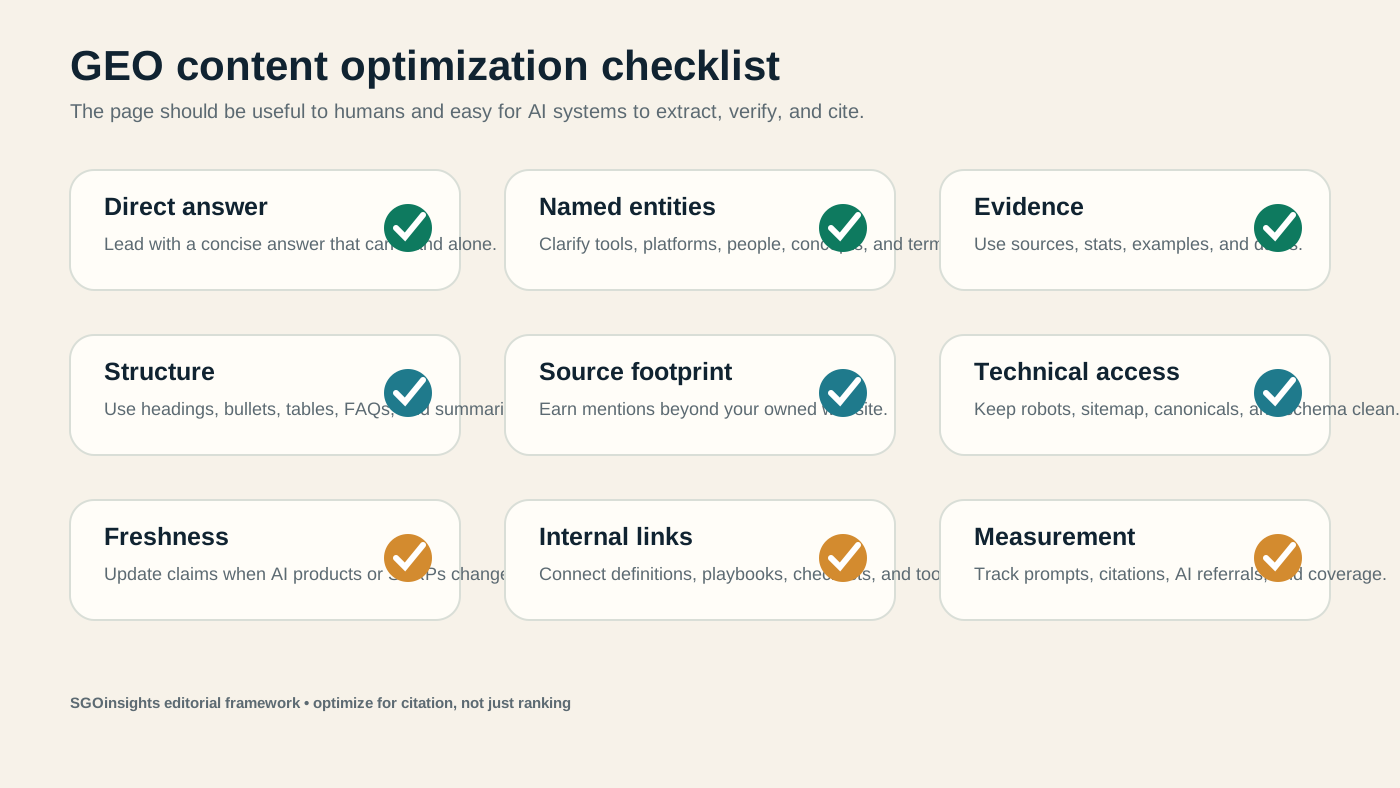
- Lead important sections with short, answer-ready summaries.
- Add definitions, examples, statistics, source links, author context, and schema only where they match the content.
- Break complex ideas into tables, bullets, checklists, FAQs, and comparison blocks that can be quoted without losing meaning.
Phase 3: Measure AI search performance
- Track whether your brand or domain appears in answers for priority prompts.
- Separate direct citations, unlinked mentions, competitor citations, and missing coverage.
- Watch referral traffic from AI assistants, but do not rely on traffic alone; many AI answers create brand exposure without a click.
Phase 4: Iterate and scale
- Refresh pages when prompts expose missing facts, stale examples, or weak source support.
- Create supporting articles for specific AI-search intents rather than expanding one pillar page forever.
- Earn external mentions through original research, useful tools, expert quotes, partnerships, and digital PR.
GEO Strategy: 12 Proven Optimization Tactics
Based on the Princeton GEO research, industry case studies, and our own analysis at SGOinsights, here are 12 proven tactics for optimizing your content for generative engines. For a broader framework that encompasses these tactics, see our AI Search Playbook.
1. Cite Statistics and Data
The Princeton GEO study found that incorporating relevant statistics and data points increased source visibility by up to 40% — making this the single most impactful tactic tested. Generative engines love verifiable data because it adds concrete value to synthesized answers.
How to apply it: Include specific numbers, percentages, study results, and quantifiable claims throughout your content. Cite your data sources. Don’t say “most companies struggle with lead generation” — say “67% of B2B companies identify lead generation as their top challenge, according to a 2025 Content Marketing Institute report.”
2. Add Quotable Expert Statements
Expert quotes and authoritative statements give generative engines ready-made, high-value snippets to include in their responses. The Princeton study found that quotations and expert attributions increased visibility by approximately 30%.
How to apply it: Interview subject matter experts and include their quotes directly in your content. Use clear attribution: “According to [Name], [Title] at [Company]…” These statements should be insightful and specific — not generic platitudes that any source could provide.
3. Use Authoritative Tone and Technical Language
Content that demonstrates subject matter expertise through precise technical language and confident, authoritative tone tends to be favored by generative engines. This doesn’t mean being jargon-heavy for its own sake — it means using the correct terminology for your field with the confidence of someone who genuinely understands the topic.
How to apply it: Write as the expert, not as the summarizer. Use industry-standard terminology. When you introduce technical concepts, define them clearly, then use them confidently. Avoid hedging language (“maybe,” “might,” “sort of”) unless genuine uncertainty is warranted.
4. Include Structured Data (Schema.org)
Structured data helps generative engines understand the nature and relationships of your content at a machine-readable level. While Schema.org markup has always been valuable for SEO, it takes on new importance in the GEO context because it helps retrieval pipelines categorize, filter, and prioritize your content.
How to apply it: Implement relevant Schema types — Article, FAQPage, HowTo, Organization, Person (for author credentials), and Review. Use JSON-LD format. Ensure your schema is complete and accurate, particularly for author and organization entities.
5. Optimize for Entity Recognition
Generative engines rely heavily on entity recognition — identifying and understanding the people, organizations, concepts, and topics in your content. Content that clearly establishes and connects entities is easier for AI systems to process and cite.
How to apply it: Clearly define key entities in your content. Mention full names before abbreviations. Link to authoritative sources (Wikipedia, official websites) when introducing entities. Use consistent terminology — don’t switch between “GEO,” “generative optimization,” and “AI search optimization” randomly; pick a primary term and use it consistently, introducing alternatives only when defining them.
6. Create Comprehensive, Well-Organized Content
Generative engines synthesize answers from multiple sources, but they strongly prefer sources that cover a topic comprehensively. A well-organized, thorough article is more likely to be cited multiple times within a single AI response — and across different queries on related topics.
How to apply it: Create definitive, pillar-style content for your core topics. Use a clear heading hierarchy (H2s for major sections, H3s for subsections). Cover the topic from multiple angles. Ensure each section could stand on its own as a useful reference.
7. Use Fluency and Readability Optimization
Content that is well-written, grammatically correct, and easy to parse is more likely to be selected by generative engines. This isn’t just about readability scores — it’s about the quality of the prose itself. LLMs can detect (and penalize) awkward phrasing, grammatical errors, and incoherent structure.
How to apply it: Invest in writing quality. Use clear, direct sentences. Avoid unnecessary complexity but don’t oversimplify technical content. Read your work aloud — if it doesn’t flow naturally when spoken, it won’t flow naturally when an LLM processes it either.
8. Build Topical Authority Clusters
Individual pages don’t exist in isolation in generative search. AI engines evaluate the broader authority of your domain on a topic by assessing how many related, high-quality pages you’ve published. A cluster of interconnected articles on a topic signals deep expertise.
How to apply it: Develop content clusters around your core topics. Create a pillar page (like this guide) supported by detailed sub-topic articles. Interlink them thoughtfully. For example, this article links to our guides on SGO, AEO, and the comparison framework — each reinforcing the others’ authority.
9. Diversify Content Formats (Tables, Lists, Definitions)
Generative engines extract different types of information differently. Tables are excellent for comparative data. Ordered lists work well for processes and rankings. Definitions are ideal for concept explanations. Diversifying the formats within your content gives the AI more extractable elements to work with.
How to apply it: Include at least two to three different content formats per major piece. Use comparison tables for “vs” topics. Use numbered lists for step-by-step processes. Lead key sections with clear, quotable definitions. Format data in ways that are both human-readable and machine-extractable.
10. Earn Third-Party Citations
Just as backlinks signal authority in traditional SEO, third-party citations signal authority to generative engines. If your original research, frameworks, or data are cited by Wikipedia, industry publications, academic papers, and other authoritative sources, AI systems are more likely to encounter and trust your content.
How to apply it: Produce original research, surveys, and data studies that others want to reference. Create unique frameworks and methodologies with clear naming. Pursue digital PR and expert commentary opportunities. Contribute to industry publications. The goal is to become a cited source in your topic’s citation graph — not just to have inbound links, but to be referenced as an authority across the web.
11. Technical Optimization (Core Web Vitals, Crawlability)
GEO doesn’t eliminate the need for technical excellence. If your content can’t be crawled, indexed, or loaded efficiently, it won’t enter the retrieval pipeline in the first place. Core Web Vitals, clean HTML structure, fast load times, and proper indexing remain foundational requirements.
How to apply it: Ensure all Core Web Vitals pass (LCP under 2.5s, INP under 200ms, CLS under 0.1). Use clean, semantic HTML. Avoid rendering your key content exclusively via JavaScript. Maintain a clear sitemap. Monitor crawl stats in Google Search Console. Make sure your content is accessible via standard HTTP requests — some AI retrieval systems may not execute JavaScript.
12. Monitor AI Search Performance
You can’t optimize what you don’t measure. As the GEO toolkit matures, monitoring your presence in AI-generated search results is becoming essential.
How to apply it: Use specialized tools to track your AI search visibility. Platforms like Otterly.ai, Profound, Peec AI, and seoClarity’s AI visibility modules let you monitor how often your brand and content appear in AI-generated answers. Set up regular audits — manually query key topics in ChatGPT, Perplexity, and Google AI Overviews to see if and how your content is cited. Track changes over time and correlate them with your optimization efforts.
How to measure GEO performance
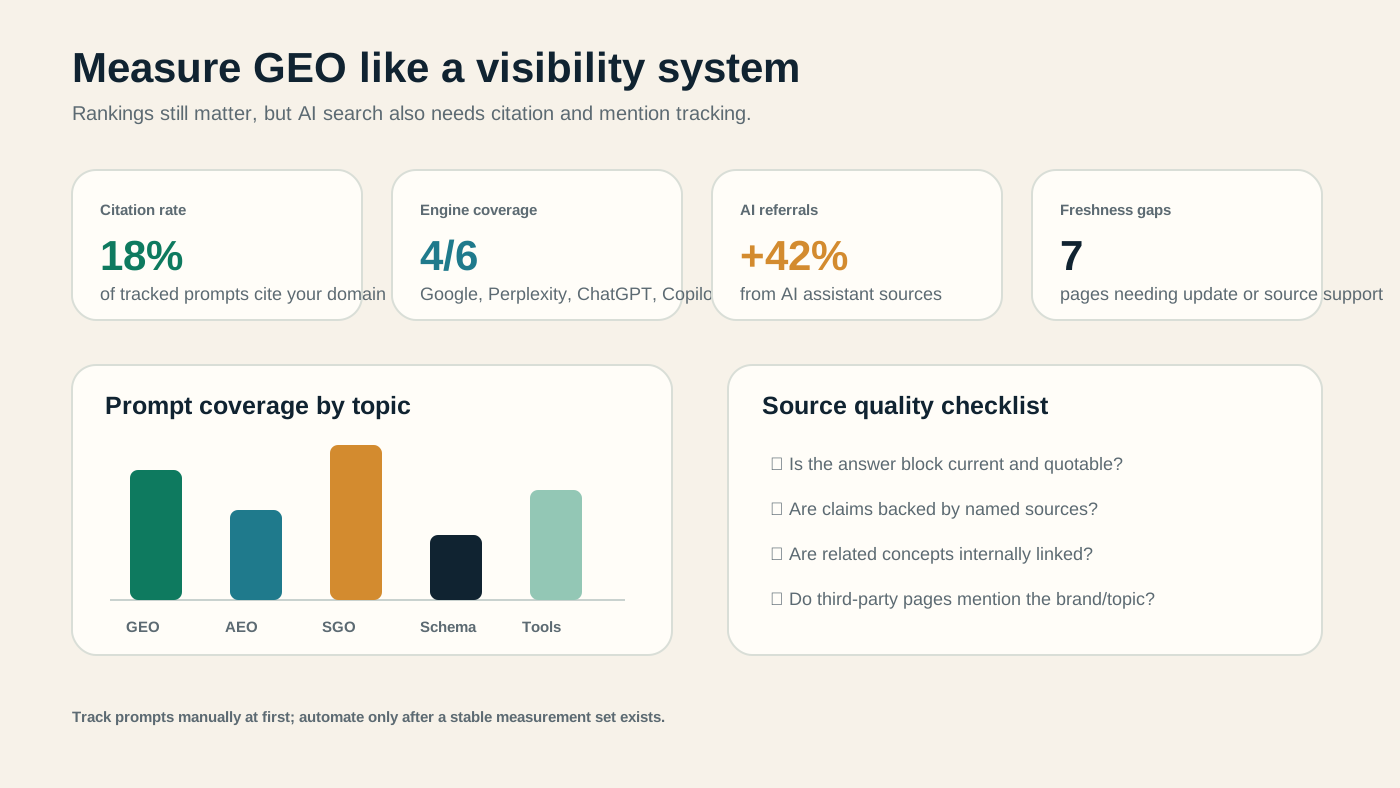
GEO measurement is still less standardized than SEO reporting, so the best approach is to combine manual prompt tracking, analytics, and qualitative source analysis.
Core GEO metrics to track
- Citation rate: the percentage of tracked prompts where your site is cited as a source.
- Mention rate: how often the brand appears in an answer even without a clickable citation.
- Engine coverage: visibility across Google AI Overviews, ChatGPT Search, Perplexity, Gemini, Copilot, and other answer systems.
- Competitor citation overlap: which domains are repeatedly selected instead of yours.
- AI referral traffic: visits from AI assistants, tracked in analytics where referrers are available.
- Content gap score: pages that lack current evidence, definitions, examples, or internal links for the prompts you care about.
Start with a spreadsheet if you do not have dedicated AI visibility software. A simple monthly prompt audit is enough to show which topics are gaining traction and which pages need stronger evidence or supporting articles.
GEO vs AEO vs SEO: Understanding the Differences
One of the most common points of confusion in the industry is how GEO relates to AEO and traditional SEO. Here’s a clear comparison:
| Dimension | Traditional SEO | AEO | GEO |
|---|---|---|---|
| Goal | Rank in search results | Be the direct answer | Be cited in AI-generated responses |
| Target | Search engine algorithms | Featured snippets, voice assistants | LLM retrieval & synthesis pipelines |
| Output format | List of ranked links | Single answer box or voice response | Synthesized narrative with citations |
| Key signals | Backlinks, keywords, technical health | Structured data, concise answers, schema | Authority, data density, citation graph |
| Success metric | Rankings, organic traffic | Featured snippet wins, voice share | AI visibility score, citation rate |
| Content style | Keyword-optimized pages | Q&A format, concise definitions | Comprehensive, data-rich, expert-level |
The key insight is that these are not competing frameworks — they’re layers. Strong traditional SEO ensures your content is findable. Good AEO ensures your content is formatted for direct answers. Effective GEO ensures your content is the kind of source that AI engines trust and cite when synthesizing complex responses.
In practice, most of the best-performing content in 2026 incorporates elements from all three. The question isn’t “which one should I do?” but “how do I layer all three effectively?”
For the full deep-dive comparison including SGO as the unifying framework, read our complete guide: SGO vs SEO vs GEO vs AEO: What’s the Difference?
The Future of GEO
Multi-Modal Search
Generative engines are rapidly expanding beyond text. Google Lens, GPT-4o, and Gemini can process images, video, and audio as part of search queries. This means GEO strategy must increasingly account for multi-modal content optimization.
In practice, this means your images, infographics, and video content can become source material for AI-generated answers — not just your text. Proper alt text, image descriptions, video transcripts, and structured data for media assets are becoming GEO essentials, not afterthoughts.
Voice and Conversational Queries
As AI assistants become more conversational, queries are becoming longer, more nuanced, and more natural. Users don’t search for “best CRM 2026” — they ask “What CRM should a 50-person B2B SaaS company use if we need strong Salesforce integration and our budget is under $50 per seat?”
This shift rewards content that addresses specific, contextualized scenarios rather than just broad keywords. Content that covers edge cases, compares options with specific criteria, and addresses real-world decision-making frameworks will outperform generic listicles in the generative search era.
Why SGO Unifies GEO + AEO
At SGOinsights, we see GEO and AEO converging into a unified discipline we call Search Generative Optimization (SGO). The rationale is straightforward: as generative engines become the default search interface, the distinction between “being the direct answer” (AEO) and “being cited in the generated answer” (GEO) blurs. Both require content that is authoritative, well-structured, data-rich, and optimized for machine understanding.
SGO provides the umbrella framework that encompasses both — a holistic approach to ensuring your content thrives in an AI-mediated search ecosystem. Whether the AI engine picks your content as a single answer or weaves it into a multi-source synthesis, SGO ensures you’re optimized for both outcomes.
The future isn’t about choosing between GEO and AEO. It’s about mastering SGO — the complete discipline of optimizing for how AI understands, evaluates, and presents information to users.
Frequently Asked Questions
What is the difference between GEO and SEO?
SEO (Search Engine Optimization) focuses on ranking your content in traditional search engine results — earning a position on a list of blue links. GEO (Generative Engine Optimization) focuses on getting your content cited and included in AI-generated answers produced by engines like ChatGPT Search, Perplexity, and Google AI Overviews. While SEO emphasizes keywords, backlinks, and technical factors, GEO emphasizes data density, authoritative tone, expert citations, and content that AI systems can easily extract and synthesize. The two disciplines are complementary — strong SEO ensures your content is crawled and indexed, while strong GEO ensures it’s selected as a source for AI-generated responses.
Is GEO replacing SEO?
No. GEO is not replacing SEO — it’s adding a new layer to it. Traditional search results still exist alongside AI-generated answers, and many queries still produce standard SERPs without an AI component. Moreover, the retrieval pipelines that generative engines use are built on top of traditional search indexes, meaning good SEO fundamentals (crawlability, indexing, page speed, clean structure) are prerequisites for GEO success. Think of GEO as an evolution of your search strategy, not a replacement. In 2026, the most effective approach combines traditional SEO, AEO, and GEO — which is what we call Search Generative Optimization (SGO).
How do I measure my GEO performance?
Measuring GEO performance requires new tools and metrics beyond traditional SEO analytics. Key metrics include AI Visibility Score (how often your content appears in AI-generated responses), Citation Rate (percentage of relevant AI responses that cite your domain), and Source Attribution Quality (whether you’re directly quoted or merely listed as a reference). Tools like Otterly.ai, Profound, Peec AI, and seoClarity’s AI visibility features can help track these metrics. Additionally, manual auditing — regularly querying your key topics in ChatGPT, Perplexity, and Google AI Overviews — remains valuable for qualitative assessment of how your content is being used by generative engines.
What types of content perform best for GEO?
Content that performs best for GEO tends to be comprehensive, data-rich, and authoritative. Specifically: long-form guides with clear structure and heading hierarchy; content that includes original statistics, research findings, and quantifiable claims; articles featuring expert quotes and authoritative attributions; comparison content with tables and structured data; and definitive explanations of concepts within your domain. The Princeton GEO study found that adding statistics increased visibility by up to 40% and including expert quotations boosted it by about 30%. Content formats that combine multiple elements — definitions, data, expert commentary, and practical frameworks — in a well-organized structure give generative engines the most to work with.
How long does it take to see results from GEO optimization?
GEO results can manifest faster than traditional SEO in some cases, because generative engines re-retrieve and re-evaluate sources with each query rather than relying on periodic index updates. If you update existing high-authority content with better data, citations, and structure, you may see changes in AI-generated responses within days to weeks. However, building the foundational authority that GEO requires — topical expertise, third-party citations, a strong content cluster — takes months, similar to traditional SEO. A realistic timeline: quick wins from optimizing existing content in 2–4 weeks, meaningful improvements in AI visibility within 2–3 months, and substantial competitive positioning within 6–12 months of sustained effort.
GEO action plan for the next 30 days
- Choose one topic cluster. Start with a pillar page and three to five supporting articles instead of optimizing the whole site at once.
- Run an AI visibility baseline. Test priority prompts in multiple AI search systems and record which sources are cited.
- Upgrade the pillar page. Add direct answers, definitions, source links, examples, comparison blocks, FAQs, schema, and a clear update date.
- Publish supporting pages. Cover narrower intents such as “GEO checklist,” “ChatGPT Search optimization,” “Perplexity SEO,” and “AI search visibility tracking.”
- Build external signals. Share useful findings, earn mentions, publish original examples, and make the page worth referencing beyond your own site.
- Re-test monthly. Update the content when AI answers reveal missing context, weak evidence, or competitor advantages.
Continue Learning About AI Search Optimization
GEO is one piece of the AI search puzzle. To build a complete strategy, explore these related resources on SGOinsights:
- What Is Search Generative Optimization (SGO)? — The unifying framework for GEO, AEO, and modern search strategy.
- The Complete Guide to Answer Engine Optimization (AEO) — Our companion guide covering AEO strategy in depth.
- SGO vs SEO vs GEO vs AEO: What’s the Difference? — A detailed comparison of all four frameworks.
- How to Optimize Your Content for AI Search — A practical playbook for implementing AI search optimization today.
The shift to generative search is not a future event — it’s happening now. The brands and creators that invest in GEO today will be the ones whose content AI engines trust, cite, and amplify tomorrow. Start with the 12 tactics outlined in this guide, measure your progress with the new AI visibility metrics, and build toward a comprehensive SGO strategy that positions your content for the next era of search.